From local expertise to global reach: advanced manufacturing for medtech success

At the recent MedTech Congress 2025 in the Jura, advanced manufacturing took center stage as a strategic lever for Swiss Original Equipment Manufacturers (OEMs) and suppliers. This article is based on a presentation given by Vincent Revol, VP Industry 4.0 & Life Sciences at CSEM, where he explored how regional manufacturers can use their existing expertise to enter global medtech markets and stay competitive long term.
Rather than focusing only on new products, the message is clear: how you manufacture can be just as decisive as what you manufacture.
Why advanced manufacturing matters in medtech now
For decades, medtech innovation has helped extend the human lifespan. However, the focus today is shifting from lifespan to healthspan – i.e. the number of years people live in good health, able to work, move and participate fully in society.
That shift, combined with broader trends, is reshaping the opportunity space for medtech manufacturers:
- Demographic change: ageing populations in Western countries and large unmet medical needs in emerging markets.
- Digital transformation: from connected devices to data-driven production and quality control.
- Regulatory pressure: more demanding standards that can either slow you down or force you to upgrade.
- Convergence of medtech and biopharma: diagnostics, devices, drugs and digital technologies increasingly interconnect.
This is both a threat and an opening. You can either sit and watch global competitors move in, or you can leverage advanced manufacturing to turn local expertise into medical-grade, globally relevant solutions.
Keep medtech R&D and manufacturing close
One of the most important strategic points for the industry is the link between R&D and production.
In Switzerland, medtech investments are heavily focused on production and R&D, with particularly strong R&D activity remaining in-country. That is not a coincidence. When manufacturers separate development from production, they lose touch with real-world constraints. For example:
- You miss critical feedback from the shop floor.
- You struggle to industrialize new ideas efficiently.
- You become less relevant as an innovation partner.
“If you’re not mastering the manufacturing process and don’t understand the issues that you’re facing in manufacturing, you’re going to lose your R&D. You’re becoming less relevant.”
This is actually good news – local production capability is an asset, not a cost center to be outsourced. The right advanced manufacturing investments can reinforce that advantage and open new medtech markets.
From precision to perfection: process innovation as a gateway to medtech success
Process innovation can be your ticket into medtech, even if you are not designing medical devices today.
Consider the case of Renata Batteries, a precision battery manufacturer in Basel-Land that traditionally supplied standardized coin cells to the watch industry. The company already had deep expertise in producing high volumes of small, precise components. But to supply medical-grade batteries for implants and wearables, “good enough” was no longer enough.
Three shifts were essential:
1. From sample-based to 100 percent quality control
In consumer markets, you can tolerate the occasional defect. In medtech, one out-of-spec battery in a batch can result in the entire lot being rejected, with serious financial and reputational consequences. Achieving this level of assurance required a completely different approach to inline quality.
2. From manual inspection to inline 3D metrology
The company implemented new 3D imaging and inspection technologies to measure shape, volume of electrolyte, and surface quality in real time.
A high-speed system captures full 3D images of each coin cell at up to 60 frames per second, checking geometry and dimensions, precise dosing of electrolyte, and cosmetic and functional surface defects.
This enabled a high throughput, fully monitored production line capable of handling around one million batteries per day while meeting medical quality expectations.
3. From local supplier to global medtech partner
With the right process innovation and certifications, the same factory could now supply medical-grade batteries at scale, entering new high-margin markets and signing its first major medtech partnerships.
The key takeaway for regional OEMs and suppliers is that advanced manufacturing is not only about cutting costs or increasing throughput – it can be the gate to new, regulated markets where quality is the entry ticket.
Turning local expertise into new medtech products
The second lesson is that local, non-medical expertise can become the foundation of new medtech products when combined with the right partners and technologies.
Take the example of Dätwyler, an elastomer specialist historically known for high-performance rubber seals for automotive engines. As combustion engines lose relevance, the company faced a strategic question: How can we reuse our deep materials expertise in a growing, future-proof market?
The path into medtech came from rethinking the core asset:
- Elastomers are soft, skin-friendly, and deformable.
- It can be engineered into complex shapes that stay comfortable on or in the body.
- It can be functionalized to pick up signals from the skin or scalp.
Together with CSEM, the company developed soft, elastomer-based electrodes for next-generation wearable devices. The demonstration device was an in-ear EEG headset: you put it in your ear, and it records brain activity (EEG) using “active dry” electrodes, without the discomfort of traditional metal electrodes.
From an innovation-management perspective, the sequence is instructive:
- Start from core expertise (complex elastomers, precision molding).
- Identify emerging medtech use cases where that expertise solves a real problem (comfort and contact quality for long-term wearables).
- Combine with specialized medtech know-how (e.g. sensors, electronics, regulatory requirements).
- Build a demonstrator that proves feasibility and signals serious intent to potential partners.
For Basel Area-based OEMs and suppliers with roots in watchmaking, micromechanics, surface treatment or precision tooling, this is a powerful blueprint: your existing know-how is not a constraint – it can be your differentiator in medtech.
How OEMs and suppliers can move from local expertise to global medtech reach
What does a practical roadmap look like if you are an owner or MD considering a move into medtech or related health markets?

1. Map your true core expertise
Go beyond the product you sell today and ask:
- What are we truly world-class at (e.g. high-speed micro-assembly, ultra-precise molding, complex coatings, functional testing)?
- Which capabilities are hard to copy for competitors in lower-cost countries?
- Where do we already operate at, or near, medical quality standards even if our current customers are not in medtech?
This is the foundation for any credible medtech diversification.
2. Scan medtech needs that match your strengths
Next, look for areas where your expertise solves a meaningful problem. For example:
- Devices that need miniaturization and mechanical precision
- Implants and wearables that require comfort, biocompatibility, or soft contact
- Diagnostic or therapeutic products that need reliable power, sensing or robust packaging
In the Basel Area, you have access to one of the world’s most concentrated life sciences ecosystems, with global pharma, leading medtech players and world-class research institutes all in commuting distance. That proximity makes it easier to understand real needs and find pilot partners.
3. Invest selectively in advanced manufacturing
Advanced manufacturing does not mean replacing your factory overnight. It means targeted investments that make your expertise medtech-ready. For example:
- Inline quality and metrology: 3D vision, high-speed inspection and full traceability to approach 100 percent quality.
- Automation and digitalization: keeps costs competitive while remaining in Switzerland.
- Process capability and validation: pass audits confidently and support customers’ regulatory submissions.
“Innovation in manufacturing is essential to drive entry into new markets for manufacturers and suppliers. It’s not just about reducing time to market or lowering production costs. It can also give new market access and competitive advantage.”
The goal is not technology for its own sake. It is to make your factory a trusted extension of global medtech supply chains.
4. Build the right partnerships from day one
Entering medtech alone is hard. The regulatory environment is complex. Clinical expectations are high. Technology stacks are evolving quickly.
This is where regional partners matter:
- Technology organizations such as CSEM can help de-risk new processes and demonstrate feasibility before full-scale investment.
- Industry network hubs like Basel Area Business & Innovation can connect you to medtech manufacturers, start-ups, clinical stakeholders and investors.
- Local peers can share hard-won lessons about audits, certifications and global customer requirements.
The combination of local expertise and strong partnerships is what turns a Basel Area-based OEM or supplier into a credible global medtech player.
Why this matters for the Basel Area
From Delémont to Itingen, the region already hosts factories that produce millions of precision components per day, operate at a quality level admired worldwide, and sit within a short drive of global medtech and pharma headquarters.
That is a unique starting point. The next step is to deliberately link that industrial base to medtech growth markets.
“Manufacturing and innovation are interlinked. You cannot separate them… local expertise is very important, and that’s what we have here in the canton of Jura.”
If OEMs and suppliers in the region embrace advanced manufacturing, stay curious about new applications, and work with the right partners, they can move from “hidden champions” to visible, global medtech players – without leaving Switzerland.
About the expert
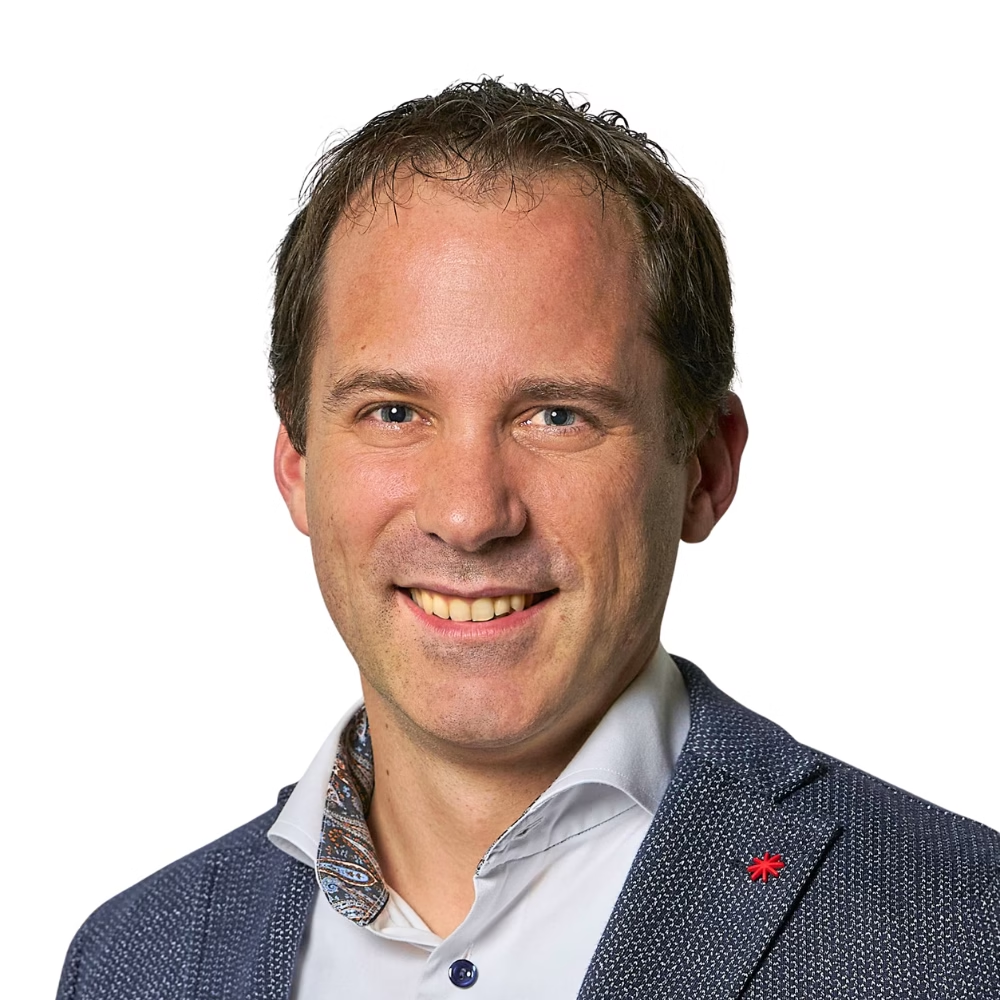
Vincent Revol has been on CSEM’s Executive Board since 2024. In his role as Vice President, and Business Unit Leader he oversees the regional sites in Alpnach, Allschwil, Landquart and Schwyz, with thematic focuses on Industry 4.0 and Life Sciences. He earned his Engineering Degree in electrical engineering from the École Polytechnique in Paris and from the Stanford University. After completing his PhD in Applied Physics from the University of Zürich, he worked for several years in the industry before pursuing a management education (eMBA) from the Zürich University of Applied Sciences.
Take your next step with Level Up
If this resonates with your situation as an OEM or supplier in the Basel Area, you do not have to design your journey alone.
Explore how our Level-Up service offerings can support your move from local expertise to global medtech reach.
You may also be interested in...

What do Basel Area-based companies need to know to stay competitive?

The second digitization: How AI changes what “digital transformation” is for