


Giving robots a sense of touch: how Inveel found its focus and why the Jura matters
Some deep tech ventures start with a clear market pull. Others start with a breakthrough technology and have to do the harder work first: find the problem worth solving, then earn the right to focus.
That was the early reality for Inveel, a startup developing sensor “skins” that can give robots something closer to a human sense of touch.
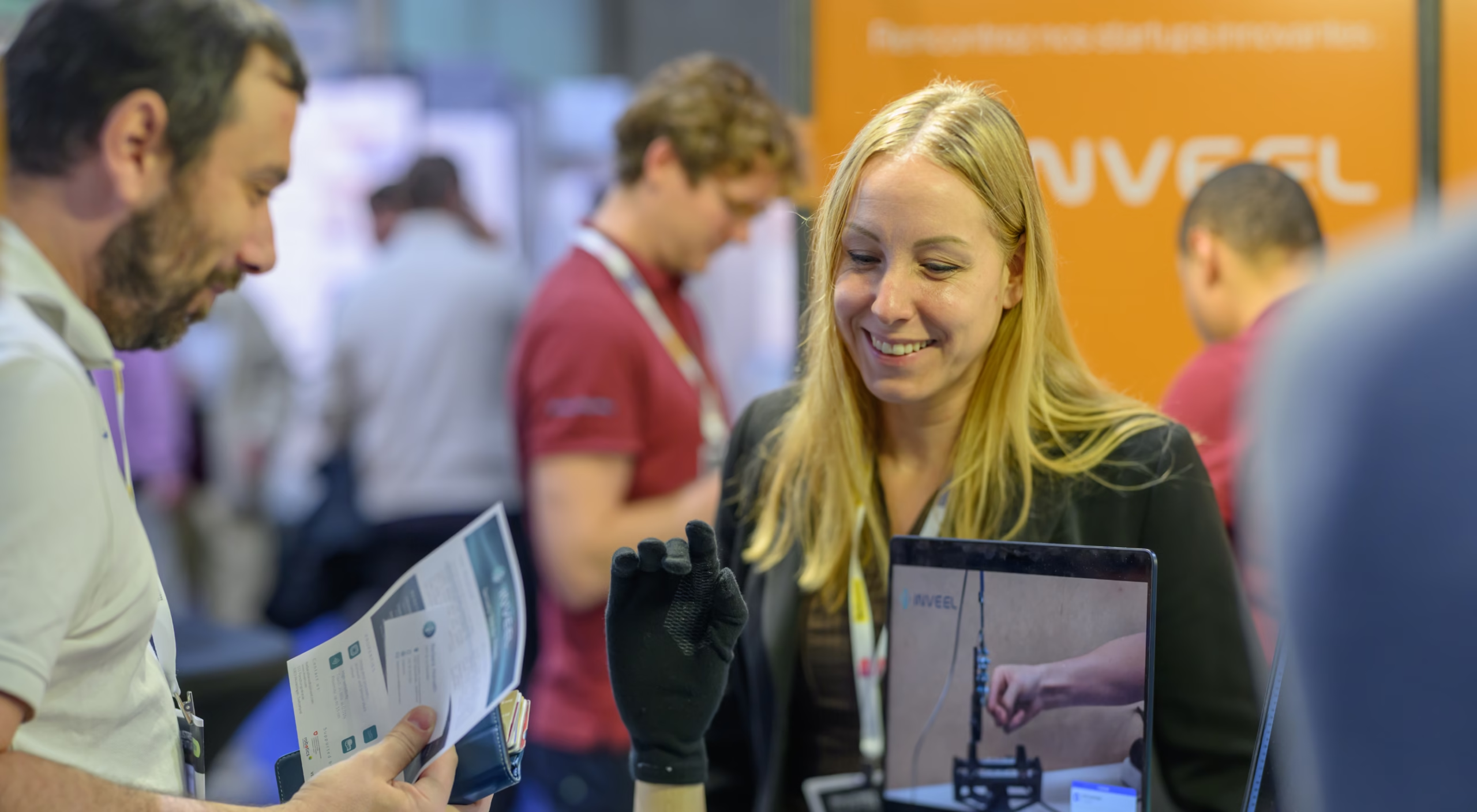
“Inveel is a startup that is focusing on developing sensor skins, mainly, but not only for robotic applications,” says Barbara Horvath, CEO and Co-Founder. “What we’re trying to achieve is develop a material that is similar to human skin, and it gives the possibility for the robot to feel touch, proximity and temperature and even other environmental sensing modalities as well.”
In this article, Barbara shares how Inveel moved from a strong technology base to a clear product direction, why market selection is as critical as engineering, and why the canton of Jura is becoming central to the company’s next phase.
Start with the technology. Then do the work to find the right use case
Inveel’s journey began with a capability: integrating high-resolution electronics into polymer materials. But Barbara is candid about what came next. “We have developed a technology … and actually after that we were more looking for the problem than the solution,” she says.
So, the team did what strong industrial innovators do: they spoke with potential customers – many of them. “Until now we’ve talked to more than 150 companies,” Barbara explains, describing a long period of discovery that included markets outside robotics before the pattern became clear.
Eventually, robotics emerged as the best first focus – not because it was the only opportunity, but because the need for sensing on surfaces was immediate and the value proposition was easier to prove.
What robotic companies consistently asked for
As Inveel’s conversations accumulated, the team was able to translate an exciting concept (“robot skin”) into concrete requirements that matter to robotics manufacturers and integrators.
One repeated theme was that the market does not want single-function sensing. “Multi-modality” kept coming up – not just proximity, not just pressure, not just temperature, but multiple sensing capabilities in one integrated solution. As Barbara puts it, the goal is “to make a skin that feels all these different sensing at the same time.”
Another recurring requirement was physical practicality: the sensing layer needs to be thin and easy to integrate, including on “funny shapes” and complex geometries. Robotics applications are rarely neat and flat – many involve spherical or curved parts, grooves, or irregular surfaces. For those cases, it is not enough for the sensor to work in a lab demo; it must adhere and perform reliably when applied to real hardware.
Performance expectations are also uncompromising. Customers want sensitivity that is genuinely useful in real environments – not a “good enough” signal, but sensing that supports safer, more precise interaction between machines and the physical world. And, crucially, they want a credible scaling path.
Barbara emphasizes the importance of a solution that can be produced not only as a prototype, but in volume – thousands, then tens of thousands, and potentially much more – with unit economics that improve as production scales.
For founders, the insight is practical: the most compelling deep tech story is rarely “our tech is amazing.” It is “our tech reliably meets the non-negotiable requirements customers keep repeating.”
Finding focus faster: the value of structured market selection
Even with strong demand signals, choosing where to focus inside robotics is its own strategic problem.
Before narrowing in, Inveel explored a wide range of segments – “drones, medical, surgical robotics, autonomous robots, industrial robots, such and such and such,” Barbara says. The issue was not a shortage of potential applications. It was selecting the best one to build around first.
Inveel joined Basel Area Business & Innovation’s InnoJura Program in November 2024 (then branded as the i4Challenge Accelerator). Barbara describes how weekly one-on-ones with an assigned coach helped the team turn a broad opportunity landscape into a decision framework.
Rather than relying on intuition alone, Inveel worked through structured criteria that are familiar to experienced industrial decision-makers. Barbara points to the importance of understanding market size, the extent of customization a segment would demand, and the underlying strength of the value proposition – in other words, whether the solution is a “nice to have” or a “must have.” With that lens, the team could categorize different opportunities, compare them more objectively, and converge on the best strategic fit.
For early-stage teams, this is often the difference between “we have many conversations” and “we have a strategy we can execute.”
Why the canton of Jura matters to Inveel’s next chapter
While “Basel” is often associated with big pharma, Barbara says the program introduced her to a wider innovation landscape – including the canton of Jura – and helped spark a major strategic move. “Eventually what we decided is that we are moving the company …” she explains, describing the decision to build a meaningful footprint in the Jura.
The rationale is concrete and operational, not just a branding story. Barbara highlights that the canton is supportive to startups and points to funding mechanisms that can help companies as they scale. She also describes a long-term advanced manufacturing ambition: “Eventually we want to establish a manufacturing site in Delémont, in the canton of Jura.”
And she underscores a regional advantage that becomes increasingly important when hardware ventures shift from prototype to production: the availability of hands-on precision talent. In Barbara’s view, the Jura’s watchmaking heritage has created a concentration of skilled technicians and practical expertise that aligns closely with Inveel’s needs as it moves toward production readiness.
Inveel is also planning its setup within the Switzerland Innovation Park Basel Area site in the Jura, with the intention to work from there as the company expands its local presence.
Next milestone: validation before commercialization
Inveel’s immediate priority is not to sell at scale yet. It is to validate that the solution performs in the field.
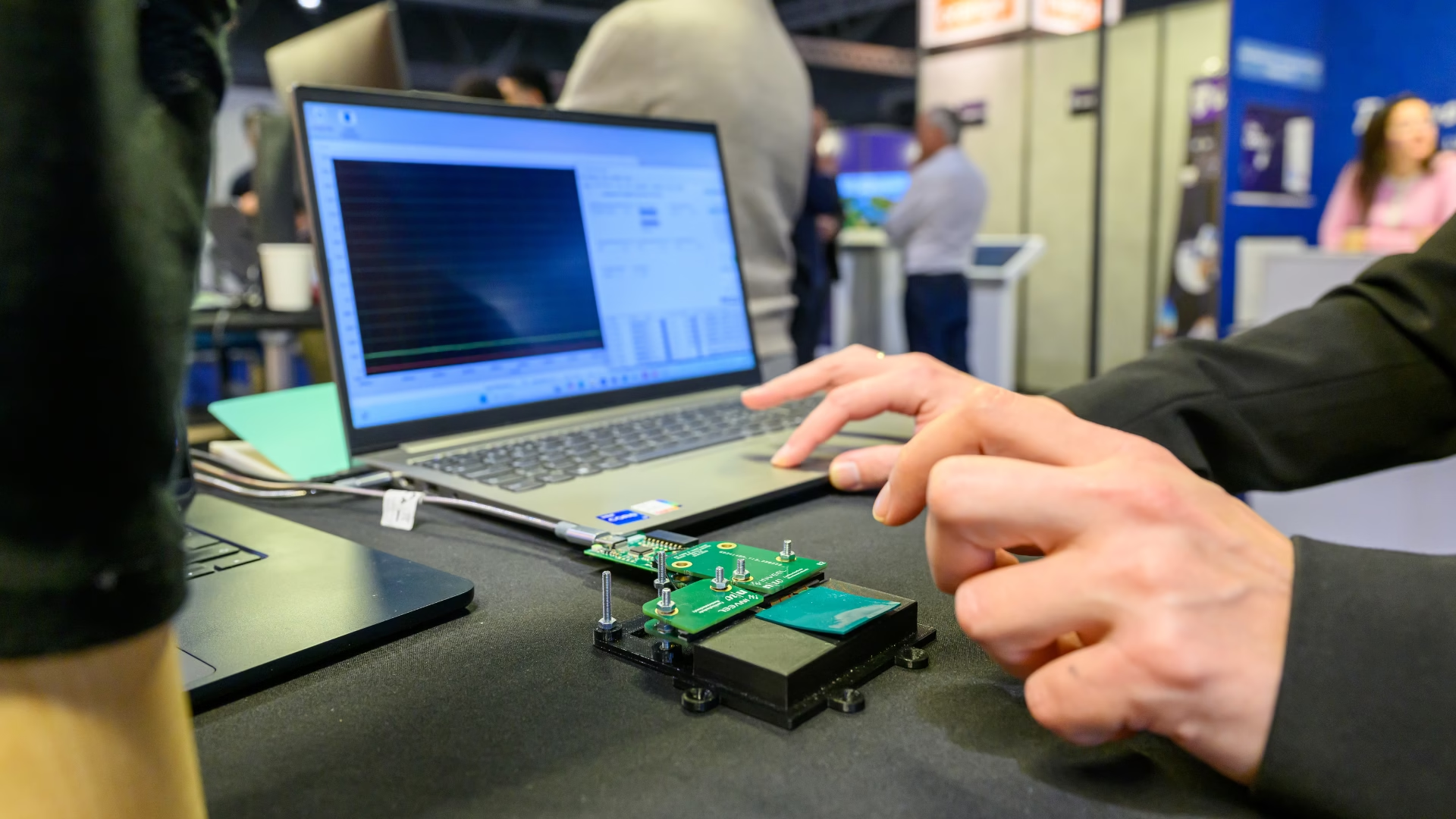
“Our next step right now is to, not yet to commercialize but rather to validate our product,” Barbara says. “We have a prototype now … companies are testing it or making pilots.”
This stage is where startups and SMEs often create the most value together. Startups gain access to real-world constraints and credible proof points that de-risk the journey to market. SMEs, meanwhile, get early visibility into emerging capabilities and the opportunity to shape solutions around practical integration requirements before they become fixed.
Barbara describes the type of support that matters most during this phase: introductions to the right partners, plus help navigating the “unexpected barriers” that appear as pilots move from technical feasibility to real deployment.
Explore collaboration and support in the Jura
If you are a startup building an advanced manufacturing or industrial technology venture in the canton of Jura, the InnoJura Accelerator can help you validate, focus, and move faster – through structured coaching and access to the right ecosystem connections.
If you are an SME looking to collaborate with startups on real advanced manufacturing needs – from robotics and automation to materials, sensing, and production-readiness challenges – the InnoJura Platform can help you identify partnership opportunities and pilot projects with venture teams.
About the expert
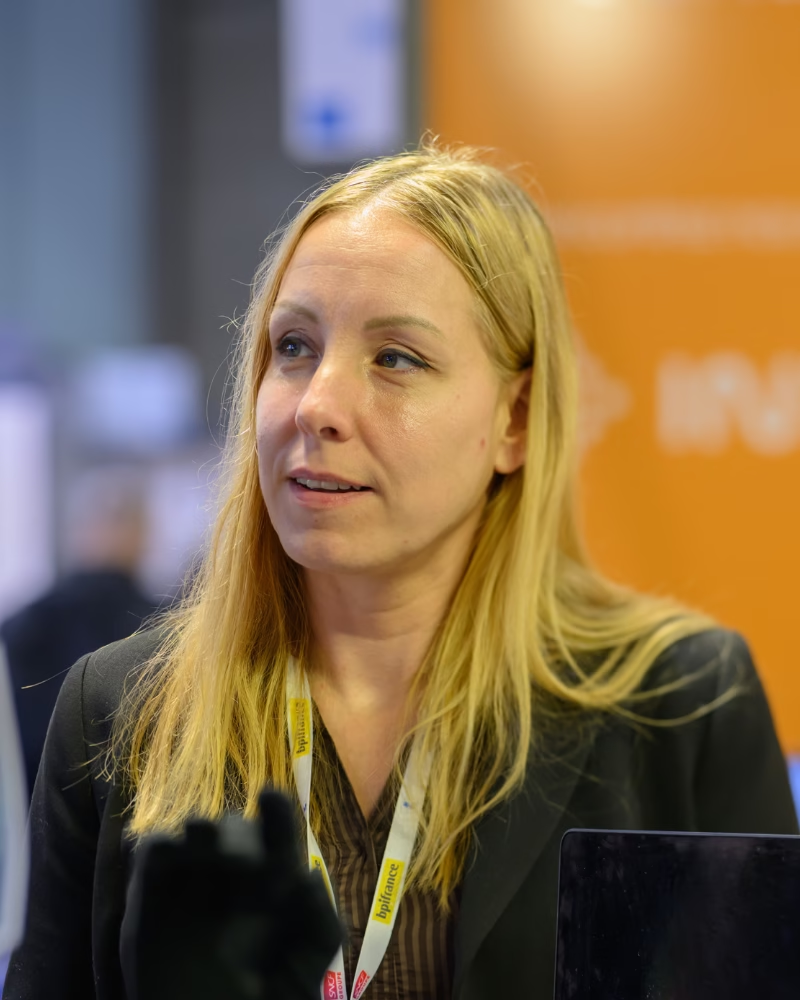
Barbara Horvath is the Co-Founder and CEO of Inveel, a deep tech startup developing flexible sensor “skins” that help robots detect touch, proximity, temperature, and other environmental signals. Inveel builds on high-resolution electronics integrated into polymer materials to create sensing surfaces that can conform to complex shapes and scale from prototypes to industrial volumes.

How to stay innovative in our fast-paced global marketplace

From local expertise to global reach: advanced manufacturing for medtech success
