


How to stay innovative in our fast-paced global marketplace
A guide for SME owners and MDs in the Basel Area

At the MedTech Congress 2025, innovation catalyst Aurélie Moser from Bambooster delivered a keynote that highlighted a challenge facing every SME across the Basel Area, and beyond: how to stay innovative in a marketplace that moves faster, demands more, and changes more often than ever before.
The ability to innovate is no longer a competitive advantage. It is now a competitive requirement. And for SMEs in our region – known worldwide for precision, craftsmanship and industrial quality – the opportunity is clear: with the right systems, mindset and tools, innovation can become a natural capability rather than a once-in-a-while effort.
What follows is a primer for SME leaders who want to build that capability and ensure their organizations are well equipped for the next decade.
Innovation is a strategic necessity for SMEs
Innovation is often misunderstood as a process of invention, disruption or radical change. In reality, innovation is simply the ability to stay valuable to customers over time.
SMEs face two types of pressures that make innovation essential:
Internal pressures
|
External pressures
|
Innovation helps SMEs manage all these forces – not through grand transformation projects but through continuous, structured improvement and market-driven adaptation.
“Innovation is really invention and commercialization. If you don’t go all the way to market launch – to a paying customer who benefits – it isn’t innovation.”
The difference between innovation and an innovation system
A company may innovate once. But remaining competitive requires something else: a repeatable innovation system.
An innovation system is not a department or a project. It is an organizational capability composed of:
- A consistent way to identify opportunities
- A clear method for testing ideas quickly
- A structured process for reducing risk when launching new innovations
- A culture and mindset that encourages curiosity and exploration
- A strategic direction that guides decision-making
This system allows SMEs to adapt – not once, but continuously. And continuous adaptation is exactly what defines competitiveness in today’s global economy.
“If you don’t like change, you’ll like irrelevance even less.”
Exploitation and exploration: the two engines every SME needs
Every SME operates with two types of energy:
Exploitation
The daily work: producing, delivering, maintaining, optimizing, serving customers, ensuring quality, improving efficiency. This world is:
|
Exploration
The future-facing work: identifying new opportunities, testing new solutions, validating new markets, experimenting with new approaches. This world is:
|
Both are essential.
Companies that only exploit become stagnant.
Companies that only explore become unstable.
The most successful SMEs in the Basel Area are ambidextrous – they run today’s business efficiently while building tomorrow’s business systematically.
Where SMEs should innovate: mapping opportunity with the Business Model Canvas
Before changing anything inside your business, you need a clear map. For SMEs, the most powerful and accessible map is the 3C Business Model Canvas. This is an adapted version of the BMC from Strategyzer, which helps you identify exactly where innovation will produce the greatest impact.
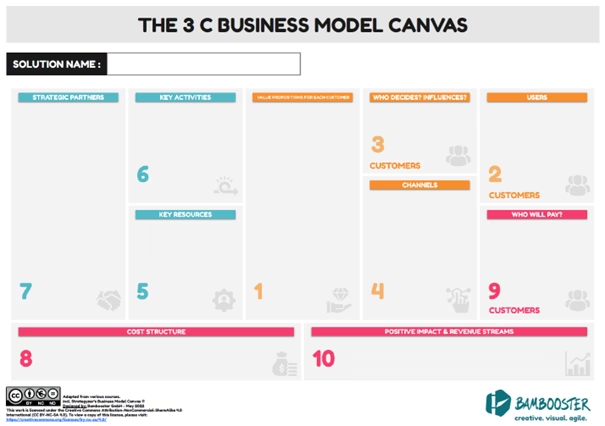
Below are the three most important innovation zones for regional SMEs.
1. Innovating on the front stage: what customers see
The “front stage” (i.e. the orange areas of the canvas) covers everything the customer experiences. For many SMEs, small changes here create massive impact.
Strengthen your value proposition
Ask:
- How could we make our offer more complete?
- How could we deliver more value without increasing complexity?
- Where are customers not getting what they truly need?
In regions like the Basel Area, SMEs often excel at high-precision components or niche expertise. Expanding these into end-to-end solutions can significantly increase value and strengthen differentiation.
Evolve your customer channels
Customers are seeking:
- faster communication
- more digital touchpoints
- clearer access to support
- online ordering and tracking
Digital channels do not replace relationships – they enhance them. SMEs that adopt smarter customer channels tend to see higher retention, reduced manual workload, and improved sales predictability.
Explore new customer segments or industries
Many SMEs in the Basel Area have deep industrial know-how that is transferable far beyond their original market. Precision machining, micro-mechanics, surface treatments, robotics and automation expertise can create strong advantages in:
- MedTech
- Aerospace
- Defense
- Advanced manufacturing
- Robotics integration
- Quality-tech and sensor-driven solutions
2. Innovating “backstage”: operations, capabilities and internal expertise
Most innovation potential is hidden inside the company – in processes, skills and partnerships that are not yet fully leveraged. This is represented by the blue areas on the canvas.
Use automation and AI to improve efficiency and quality
Automation and AI are particularly powerful for SMEs because they:
- reduce manual, repetitive work
- improve consistency and quality
- free employees for higher-value tasks
- shorten lead times
- reduce internal costs
These gains allow SMEs to reinvest in innovation, talent and market expansion.
Monetize your expertise as a service
Many SMEs have highly specialized knowledge that is valuable far beyond the products they manufacture. For example:
- predictive maintenance
- materials expertise
- robotic integration
- medical-device quality processes
- precision microfabrication
- compliance and regulatory know-how
Turning these into service offerings opens new revenue streams with higher margins.
Build strategic partnerships
Partnerships accelerate innovation. SMEs benefit most from partnerships that provide:
- access to new skills
- access to new markets
- shared development costs
- faster customer validation
- complementary capabilities
In the cross-border Basel Area, partnerships are one of the most powerful tools SMEs can use.
3. Innovating your monetization model: how you generate revenue
Covered by the pink areas of the canvas, one of the most overlooked innovation levers is the business model itself. SMEs often assume they have to keep selling products the way they always have. But several powerful alternatives exist:
Reduce cost through smarter production
Automation, process optimization and digital tools all help SMEs protect margins and build resilience.
Target customers with higher willingness to pay
This might mean serving a different end user, repositioning your offer, creating a premium tier, or offering bundled services. Many SMEs can significantly increase revenue simply by reframing value for a different customer group.
Create recurring revenue through subscription models
Recurring revenue is not just for software. SMEs can create subscription layers around:
- data
- analytics
- predictive maintenance
- remote monitoring
- calibration services
- training and certification
- extended warranties
This makes revenue more predictable and strengthens customer relationships.
How SMEs can innovate effectively: mindset, risk and repeatability
Innovation is not only where you innovate, but how you innovate. SMEs need three critical capabilities.
1. Build an exploration mindset
Innovation requires curiosity, flexibility and a willingness to learn from outside the organization.
This mindset develops when teams:
- ask better questions
- meet more customers
- challenge assumptions
- observe real-world behavior
- test instead of debate
“You need the ability to bring back good-quality data during a conversation – because without good data inside the company, you can’t do anything.”
2. Manage the three risks of innovation
Every idea faces three risks:
Desirability
|
Feasibility
|
Viability
|
Strong innovation systems address all three risks early, repeatedly and efficiently.
3. Use a repeatable process to reduce uncertainty
Innovation is not linear like traditional project management, with defined steps and a clear goal.
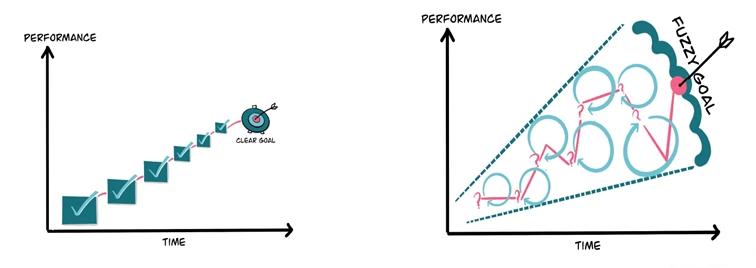
Instead, long-term effective innovation usually has a “fuzzy” goal, and getting there involves loops of:
- Customer insight
- Idea generation
- Quick tests
- Learning
- Refinement
- Scaling
When SMEs institutionalize this approach, innovation becomes faster, cheaper and less risky.
A long-term innovation compass for your SME
To remain competitive over the next decade, every SME needs an innovation compass focused on:
Destination
|
Direction
|
Competencies
|
This trio – destination, direction and competency – forms the foundation of SME resilience in fast-changing markets.
To explore how our Level Up services can support your SME’s innovation journey, visit our service offering overview page.
Feeling pressure to change but unsure how to start without wasting time and money?
Aurelie Moser is the founder of Bambooster, on a mission to remove waste of time, energy and resources in organizations. Bambooster helps SMEs build simple innovation systems that reduce risk, free up teams’ time, and create results customers will pay for. Aurelie helps create future-proof and high-performing teams (humans + GenAI), and develop innovation strategies and products faster.
All graphics in this article are © Bambooster and re-published here with permission.

You may also be interested in...

What do Basel Area-based companies need to know to stay competitive?

The second digitization: How AI changes what “digital transformation” is for
