The second digitization: How AI changes what “digital transformation” is for

A second digital wave is breaking over industry – and it will not behave like the first one.
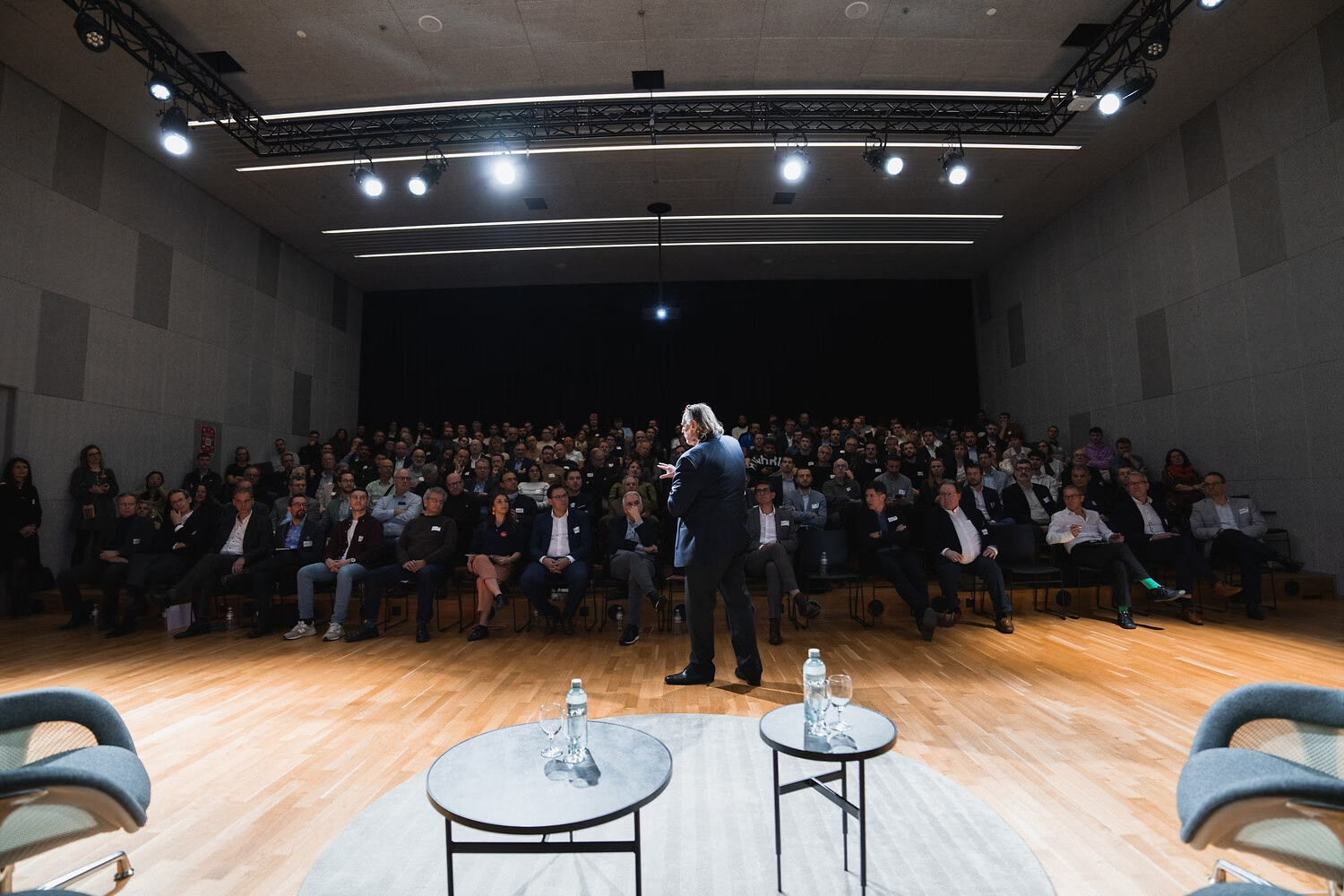
That was the prediction of Dr. Xavier Comtesse at our event Le Tout Connecté 2026, where he argued that many leaders feel the scale of what’s happening with AI, but still struggle with a practical question: what do we actually do with it inside our own organization?
Xavier Comtesse’s answer is deceptively simple.
The difference between the first and second digitalizations
The first digitization, the one most companies have lived through since the 1960s, mainly turned structured data into operational leverage – names, numbers, records, ERP fields, spreadsheets, deterministic rules.
The second digitization is different: it’s about finally being able to work with the other kind of data – the messy, human, sensory, contextual information your business produces every day, but rarely uses.
And because AI can now “read” this previously unreadable data at scale, the strategic payoff shifts too: from digitization as a cost center (often justified by productivity promises) to digitization as a growth engine that can create new services, new revenue streams and new margin.
The tsunami metaphor: The first wave was not the dangerous one
Xavier Comtesse frames the moment with an image he wants business leaders to remember – a tsunami. The sea pulls back, people step closer to the shoreline, and then the waves arrive. But the real danger is not the first wave. It’s the second, often larger wave that rides on top of the first.
"A tsunami isn’t a single wall of water – it’s a succession of walls. And it’s usually the second wave that’s most dangerous."
In other words: if your organization feels like it has already “done digital”, that confidence may be exactly what puts it at risk. The second digitization is not an incremental upgrade to existing IT. It changes the addressable raw material of the business.
Dark data: The 95% your company produces, but doesn’t use
To make the shift concrete, Xavier Comtesse introduced a useful mental model: structured vs. unstructured data. Structured data is what fits cleanly into your systems. Unstructured data is everything else – audio, video, images, free text, informal conversations, machine noises, notes, emails, chats, even sensor streams that don’t map neatly to decision-making.
He calls this unexploited mass dark data – the “dormant stock” of information that organizations generate but typically ignore.
His comparison is intentionally extreme: in the universe, visible matter is around 5%, with the rest described as dark matter and dark energy. In organizations, he argues, the proportions can feel similar – you operate on the 5% you can see, while the 95% remains largely untapped.
That 95% contains commercial and operational signals – what customers complain about in emails, what engineers discuss in meetings, what a machine “sounds like” before it fails, what’s hidden in the photo archive you collected for compliance and then forgot.
The breakthrough is that AI – especially modern language and multimodal models – can now extract meaning from these formats quickly, cheaply and at scale.
From “digital for productivity” to “digital that pays”
Most companies have an intuitive memory of the first digitization: major systems, long projects, fragile integrations, high spend – often justified by modest productivity gains. Xavier Comtesse’s claim is that the second digitization flips the economics.
Instead of digitizing what you already structured (and already measured), you turn previously unusable data into something you can sell, operationalize or productize.
“We’re moving from IT that costs a lot for limited productivity gains, to IT that earns money. Profit is finally at the end of digital.”
That’s why he keeps returning to a single strategic test: does this AI initiative create growth – not just efficiency?
Three “quick win” examples that show what changes
Xavier Comtesse’s strongest argument is practical: the second digitization becomes real when you see how small, targeted uses of AI unlock new value from dark data.
1) Turning public signals into customer-specific offers
He described a food wholesaler that monitors restaurant menus online, compares ingredients against the restaurant’s purchasing history, and then automatically identifies missing categories – prompting a tailored outreach (for example, a discount on items the restaurant uses but doesn’t buy from them). A human could do this manually for a few accounts; AI makes it scalable.
2) Smart meters: When “more data” becomes actionable
Utilities increasingly receive granular consumption data every 15 minutes. On its own, that doesn’t change anything. But analyzed through AI, it can detect anomalies that suggest a failing appliance (a defective fridge, a malfunctioning cooker), or help smooth demand peaks by recommending behavioral shifts. The win is twofold: better customer outcomes and better economics for the provider.
3) From photo archives to predictive maintenance services
A water infrastructure manufacturer had collected hundreds of thousands of valve photos over years for documentation. AI analysis of those images can identify corrosion, age, model references and fit-for-purpose issues – enabling remote predictive maintenance and even redesign recommendations. The most important shift: what used to be “documentation overhead” becomes a paid service layer.
Across all three, the pattern is the same: the asset was already there. The value was inaccessible because the data format was inaccessible.
Start with quick wins – not a “big transformation”
If there’s one operational prescription Xavier Comtesse repeats, it’s this: start with quick wins.
In his framing, an AI quick win is not a pilot designed to impress a steering committee. It’s a small, targeted application that is:
- fast to implement (days or weeks, not months),
- low risk (limited sunk cost),
- visible (users can immediately feel the improvement),
- and educational (it reveals where your dark data is, and what it could enable).
He even gives an order-of-magnitude benchmark for leadership attention: projects that can be done in under two months and under CHF 20,000 – and sometimes far less.
“Don’t go and take lessons. Do it yourself. Quick wins are how you learn what’s possible.”
The capability you need is small – but it must be in-house
Quick wins are not only about speed. They are how an organization builds judgement: what to trust, what to scale, what to ignore, and where the real data leverage sits.
That’s why Xavier Comtesse insists on a small internal nucleus – an “AI lab” in the plainest sense: two or three people from your own IT or digital team, not necessarily full-time, tasked with finding and implementing quick wins against your own dark data.
The rationale is straightforward: vendors can sell you tools, but they cannot own your context. The riskiest scenario is outsourcing your understanding at the exact moment understanding becomes the competitive edge.
What leaders should take away
The “second digitization” is not a slogan. It’s a reframing of the playing field:
- The raw material expands: not just what your systems can store, but what your organization produces.
- The economics shift: from digitization justified by productivity to digitization that can create revenue.
- The strategy changes: from big-bang transformations to iterative quick wins that build capability and momentum.
- The operating model matters: you don’t need a massive AI department, but you do need an in-house core that learns by doing.
The organizations that treat this wave as a practical exploration – and build the habit of turning dark data into customer value – will be the ones running uphill when the second wave hits.
About the expert
Dr. Xavier Comtesse is a mathematician and computer scientist who has worked at the intersection of technology, communication and innovation since the 1970s. He has founded multiple Geneva-based startups, held senior roles in Swiss science diplomacy in Washington and Boston (where he helped create the Swissnex concept), and later served as the first French-speaking Director of the think tank Avenir Suisse, publishing several books on innovation and governance. He also co-founded ManufactureThinking.ch, an industrial think tank focused on the new industrial revolution.