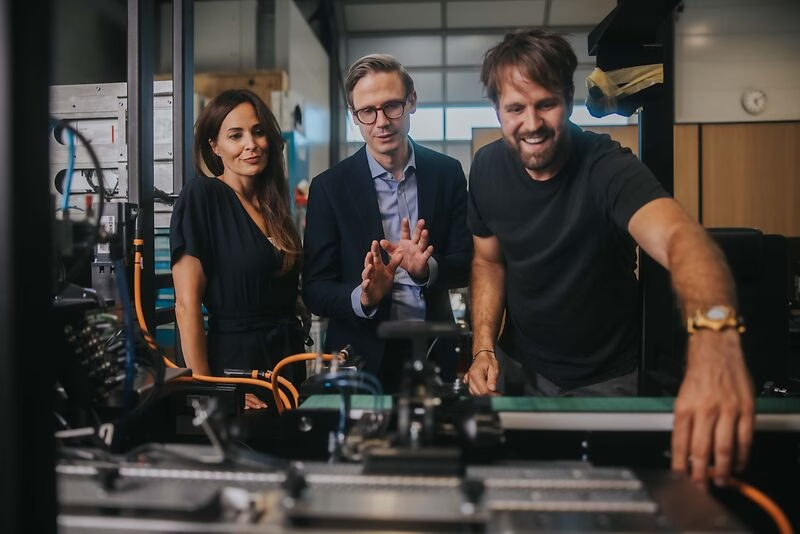
Asset DOC: three startups, one shared offer – a collaboration built through InnoJura

Industrial innovation rarely fails because of a lack of technology. It fails because solutions stay fragmented, for example when making an asset evaluation – sensors here, data there, analytics somewhere else – and no one owns the full picture.
For Vladimir Vilde (Dxan), Vinod Govindan (Oceans.ai), and Normand Overney (ColombaLink), the real breakthrough didn’t come from building more features. It came from recognizing where each of their companies was strongest – and choosing collaboration over duplication.
What began as three separate journeys through the i4Challenge, the predecessor of today’s InnoJura Accelerator, has evolved into a three-way collaboration – provisionally called Asset DOC – combining data capture, data consolidation and algorithmic analysis into a single, integrated industrial offering.
Three founders, three perspectives on the same challenge
All three startups entered the program from different angles, with different levels of maturity and different market assumptions – but they were ultimately circling the same industrial reality.
ColombaLink: from technical conviction to market clarity
Normand Overney founded ColombaLink after studying software engineering at the University of Basel. His team developed Monidas, an IoT monitoring solution designed to collect and manage industrial data securely and independently.
What they lacked wasn’t technology – it was traction.
“We were very idealistic,” Normand reflects. “We believed strongly in our solution, but less in what the market was actually asking for.”
Joining i4Challenge forced a shift. Customer conversations, positioning, pricing and go-to-market strategy suddenly mattered as much as the product itself. “It pushed us to think beyond the technology – to think like a business.”
Dxan: turning dormant data into decision support
Vladimir Vilde joined i4Challenge shortly after moving to Basel. For him, the accelerator was both a market entry point and a network-building tool.
“I was new to the region,” he explains. “Applying to i4Challenge was a way to connect with industrial players and understand real use cases.”
Dxan positions itself as a “digital toolbox” – software that helps industrial companies unlock value from existing operational data. The emphasis is on supporting human decision-making, not replacing it.
The challenge? Integrating smoothly into complex industrial environments without overpromising or over-scoping.
Oceans.ai: recalibrating toward scalable impact
Vinod Govindan founded Oceans.ai in Singapore and spent years running pilots and proofs of concept across industrial settings. Those experiments delivered an uncomfortable truth.
“After a lot of pilots and POCs, we realized we needed to recalibrate our approach to the market,” he says.
The answer was a shift toward a more modular, toolkit-based offering – one that could scale across assets and sectors, particularly in Industry 4.0 and advanced manufacturing contexts such as predictive maintenance and condition monitoring.
When coaching turns into collaboration
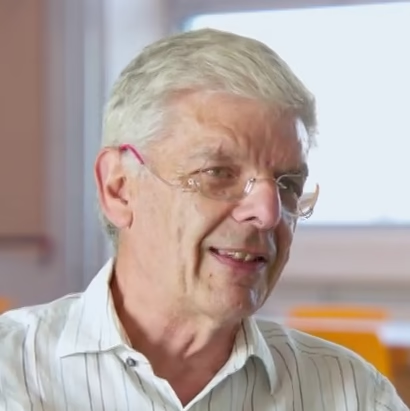
Christophe Walch has coached startups in the i4Challenge program for more than five years. His focus is unapologetically pragmatic.
“My goal is simple,” he says. “Help them earn their first money. Until there’s money in the account, you’re not really in the market.”
With these three startups, Christophe noticed something unusual. Each was inching toward adjacent domains – sensors, platforms, analytics – but none was strongest across all of them.
“Instead of each startup trying to cover everything and being a bit shaky in the neighboring domain,” he explains, “we asked a different question: what if we bring these three elements together?”
The collaboration didn’t happen by chance. Normand had met Vladimir in passing. Vinod was already exploring partnerships. But it took structured coaching – and a nudge from the program – to turn informal overlap into a concrete joint effort.
“It created a synergy,” Vladimir says. “Almost a push to really start working together.”
Asset DOC: one offer, three complementary strengths
Asset DOC – a working name – is not a new company. It is a formal collaboration, governed by a signed agreement, in which each startup remains independent while contributing a defined capability.
The structure is deliberately simple:
- Data capture – secure, independent sensors that can be deployed without interfering with existing client networks
- Data consolidation – a platform that brings together sensor data and existing operational data into a unified pool
- Data intelligence – algorithmic analysis that transforms raw data into actionable insight
For industrial clients, the value lies in integration. Instead of stitching together multiple vendors, they engage with a coordinated solution – one that can adapt as data quality, use cases, and operational needs evolve.
“There’s a feedback loop,” Christophe notes. “If the analysis shows that the data quality isn’t good enough, you can immediately adjust how the data is captured. That’s very powerful.”
By bringing together these solutions they aim to deliver prognostic intelligence to customers on assets condition, improving operational costs, not only on past data, but adding contextual and corroborative data. They deliver:
- Improved asset condition visibility
- Enhanced data convergence with supervised and moderated learning
- And future proofing your assets and business performance
From concept to reality: testing the collaboration at BE5.0
The collaboration’s first real stress test came at the BE5.0 conference in Mulhouse, France, where the three startups delivered a joint demo in a live environment.
Sensors were installed at the venue entrance to track movement patterns – frequency, intensity, flows. Data was collected, consolidated, and analyzed in near-real time.
For the founders, it was more than a showcase.
“We needed to learn how to work together,” Vladimir says. “To see what works and what doesn’t.”
Vinod describes the final sprint with a familiar startup analogy. “It felt like a hackathon at times – but in a good way.”
The result wasn’t perfect, but it was proof: the collaboration works, the integration is feasible, and the combined offer resonates in conversations with potential customers.
Why collaboration matters in Industry 4.0
In Industry 4.0 and advanced manufacturing, credibility matters as much as capability. Industrial buyers look for solutions that are robust, scalable and supported by teams who understand operational reality.
According to Christophe, collaboration accelerates that credibility. “Together, they’re stronger. More solid. More convincing for customers.”
Vinod agrees. “The solutions clearly complement each other. We can stay independent but align around a shared goal and a shared value proposition.”
Instead of three startups each trying to be everything, Asset DOC allows each to stay focused – while still delivering an end-to-end answer.
The InnoJura role: creating the conditions for collaboration
This story is first and foremost about founders. But it also reflects what the InnoJura Accelerator is designed to enable.
“Asset DOC is exactly the kind of outcome we aim for,” says Sébastien Meunier, Director SME Innovation at Basel Area Business & Innovation. “Strong teams with distinct capabilities choosing collaboration over competition and moving faster toward real market engagement.”
He sees the InnoJura Program’s role as structural rather than directive.
“We don’t build solutions for startups,” Sébastien adds. “We create the conditions where the right people meet, test ideas quickly, and turn promising concepts into commercial reality.”
The fact that the collaboration emerged across different i4Challenge cohorts underlines the value of continuity – and of the InnoJura platform as the next evolution of the program.
What comes next
For Asset DOC, the next challenge is clear: moving from demos and early feedback to real projects and paid deployments.
“The next step is commercial engagement,” Vinod says. “Turning this into real-world use cases that generate revenue.”
The technology is there. The collaboration is in place. What’s needed now is action.
That next chapter will be written at the Switzerland Innovation Park Basel Area – Jura as a base for collaboration, testing and proximity to industrial partners.
Want to turn an Industry 4.0 challenge into an advanced manufacturing advantage?
The InnoJura Program connects startups and SMEs to test, build, and scale solutions faster.